Yielding Checking Account with ether.fi
A delta-neutral ETH basis trade paired with ether.fi’s borrow-mode Visa card turns productive collateral into a high-yielding, spendable checking account.
> August 7, 2026
I’m writing today to discuss a primary idea I’ve been playing around with over the last few months in the wide world of defi. I’m a semi-technical speculatoooor when it comes to defi strategies - and have been pilled for the last year+ on putting a unique twist on various basis trades.
Coincidentally, I found myself very much intrigued with the ether.fi spend product - finally, a real product that I could use in my day-to-day life and tangibly show my wife that all this obsessive financial/defi acrobatics actually meant something.
And then just the other day, @nomaticap shared @6942_eth’s post about their calculator they built to track the “buy, borrow, die” strategy that they had deployed on ether.fi rails. That pushed me over the edge - I had to at least put this concept out there and see if I’m crazy/get some real feedback.
So the idea centers around leveraging a basis trade in tandem with the ether.fi spend product and specifically utilizing the borrow mode (against collateral). So here’s what we’re looking at:
The basis trade
- The LONG leg of the basis trade is composed of weETH spot that is deposited into your ether.fi vaults (and can be borrowed/spent against).
- The SHORT leg of the basis trade is a “lightly levered” perps short using a perps dex of your choice (I’ve been using Reya recently to collect points and also because it allows you to collateralize your perps position with wstETH).
So, the net exposure of the strategy should be NEUTRAL - the USD value of your weETH and wstETH collateral should equal the USD value of your ETH perps short. BUT, like any good basis trader knows, you are collecting both the funding rate from the perps dex and also the staking rewards on your LST collaterals. Additionally, what’s super cool about this specific basis trade is that you can spend against your LONG leg of the strategy with your Visa ether.fi card. And with that, you receive an additional 3% cash back on your spend.
Now, I personally treat this as a “checking account” where I pay the balance of my “debt” off every month - so over the course of the month I spend/borrow against my LONG side of my strategy with my Visa card and then I pay the debt balance off come the beginning of the next month. Mathematically, if I assume that the spend is perfectly spread over the month then the 4% debt service is actually cut in half to 2% (per year) - thus making the rewards of 3% > the debt service of (net) 2%. Then you layer in the funding rate and staking rewards and you’re talking about a super juicy product. The levered checking account. The math ends up math’ing as so (at least I think it does):
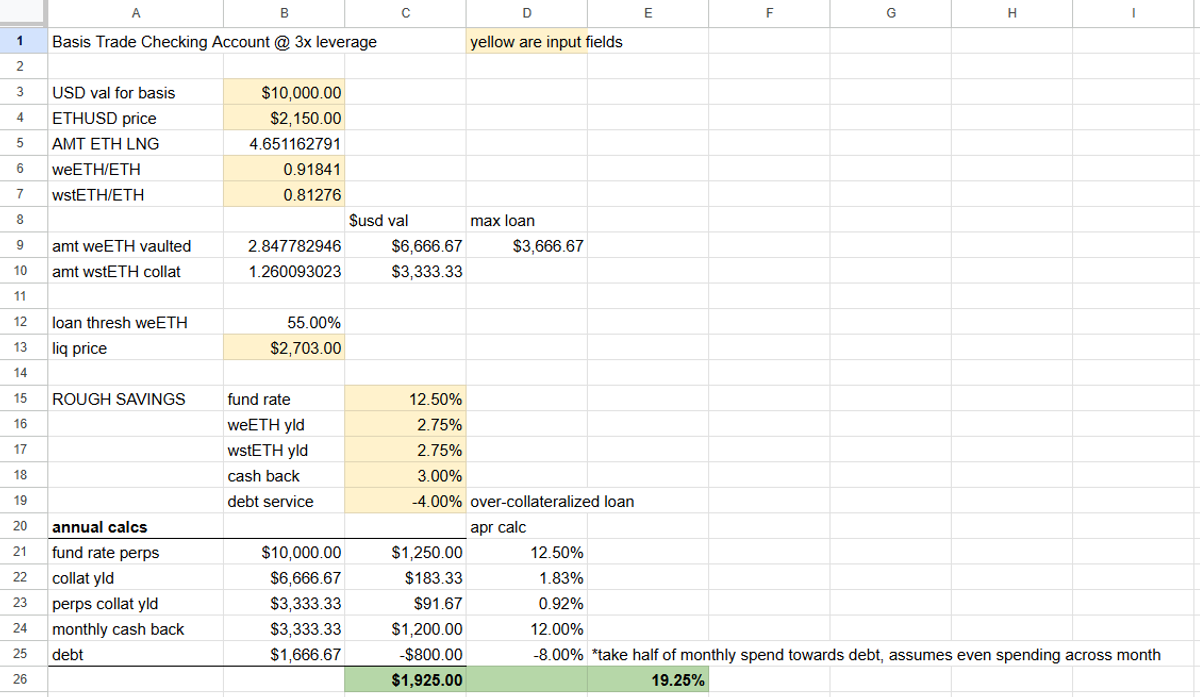
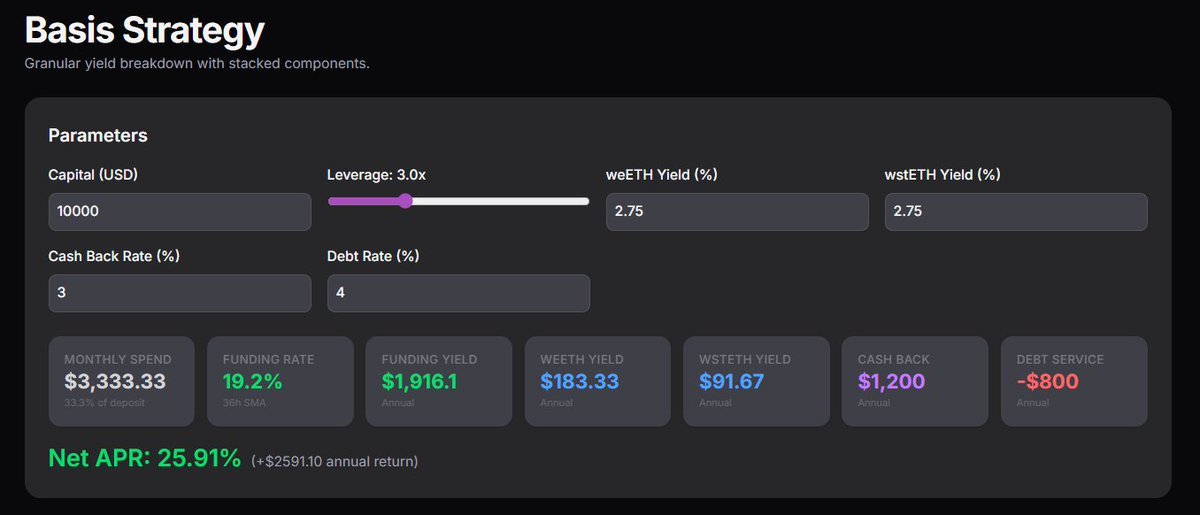
Now, I’m just a pretty normal guy - and have seen some elaborate mental gymnastics performed over the last few years to eek out some yield in some very niche corners of the internet. BUT THIS THING GETS ME FIRED UP. I mean, I realize there are some risks involved by incorporating a 3x levered short in here - but this is not a crazy complicated strategy. AND I’M LITERALLY SPENDING AGAINST IT WITH A VISA CARD FOR MY DAY TO DAY PURCHASES. I too have been working to turn this spreadsheet into a more tangible calculator (see below), but am also very interested to hear what you all think - where are the holes in this strategy?
Takeaways and learnings from the strategy once in practice
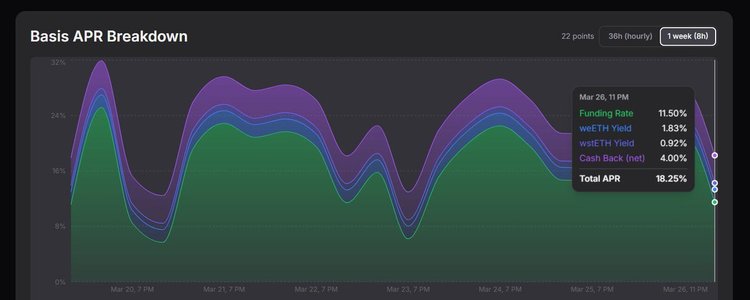
- I’m very much aware that funding rates don’t always move/stay in your favor (as evidenced over the last 60 - 90 days). But even over times where funding rates dip to the negative, they still seem to bias back above zero. I frequently remind myself of the Chaos Labs report from a couple years back that analyzed how funding rates tend to normalize at a positive rate.
- The cash back is HUGE. I originally planned the example numbers earlier in this article to reference an initial capital starting value of $100K but ended up dialing it back to $10K to demonstrate the influence of the cash back portion of the strategy (it’s much more realistic to spend $3,333/month than $33,333/month - at least for me). When you net out the cash back with the debt service, it has a meaningful impact on the overall “return” of the strategy (net net ~4%).
- There is a very real risk playing with leverage here - the example above outlines a 3X levered short, but you could also do it with 2X leverage or none at all to be even safer. Personally, I’m comfortable sticking at this leverage value. I’m also currently looking at applying some rebalance automation via a mix of AI and smart contracts.
- ether.fi liquidation risk - this has to be under consideration too since the spending portion of the strategy is borrowing stables against volatile assets. I very much appreciate the thoughtful consideration @MikeSilagadze has made with his very conservative LTV thresholds. I believe I heard him mention on a recent @edge_pod that even during the 10/10 meltdown, there were no liquidations on ether.fi vaults. Anyway, this has to be taken into consideration and with the recurring monthly debt paybacks, I’m comfortable with the structure of the strategy.
So, at the end of the day this strategy nets out to a very high-yielding savings product that allows you to spend via Visa against it. In exercising it, you’ve essentially become your own bank - you’re loaning assets to yourself to fund your day-to-day life. You’re not going into debt against any credit card or other entity, but rather just being creative with your funds and allowing savings to both generate yield and also collateralize against spending.
Let me know your thoughts - let's keep the convo going. I'm happy to share my dashboard/calculator if people are interested.
just use ether.fi.
Originally published as an X Article on March 27, 2026.